 Trusted Since 2001


.svg)
- Commercial Locks
- Parts and Accessories
- Bolts and Latches
Bolts and Latches
$102.90
$64.83
$130.00
$81.90

$130.00
$81.90
$83.70
$52.73
$49.90
$31.44
What Is a Door Bolt Latch and Which Type Does Your Opening Need?
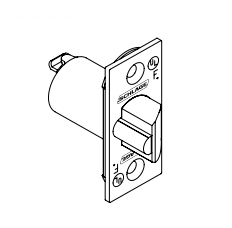
A latch bolt is the spring-loaded tongue that holds a door closed when it shuts. Push the door closed and the angled face of the latch compresses against the strike, then snaps into the strike pocket when it clears the lip. That's the core mechanism in virtually every cylindrical and mortise lock on a commercial door. But "latch bolt" covers several distinct designs, and ordering the wrong one creates a problem that doesn't show up until installation day.
Spring latches are the standard: a beveled bolt that retracts on contact and springs back into the strike pocket. No secondary mechanism. These work on passage and privacy function doors where the lock controls access, not the latch itself.
Dead latches (guarded latches) add a guard plunger sitting directly beside the main latch bolt. When the door closes, that plunger contacts the strike face and mechanically deadlocks the latch in the extended position. It can't be pushed back with a card, a tool, or any improvised method while the door is closed. Every exterior commercial door with a latch, and every interior door holding anything of value, should have a guarded latch. Unguarded latches have legitimate applications but shouldn't be the default on any secured opening.
Deadlocking latches serve mortise locksets where the latch and deadbolt operate from a single case. The Sargent 7-Line and 10-Line latches in this catalog fall into this category.
How to Measure Your Door Latch Bolt Backset
The backset is the distance from the edge of the door to the center of the bore hole where the lock cylinder sits. Measure from the door edge to the center of the existing knob spindle hole, or to the center of the cross bore if the hardware is already removed.
Standard commercial doors use a 2-3/4 inch backset. Residential doors often use 2-3/8 inch, which is why retrofit situations on older commercial buildings sometimes require checking before ordering. If you order a 2-3/4 inch latch for a 2-3/8 inch prep, the faceplate overhangs the edge and the latch won't seat correctly in the strike.
Faceplate dimensions matter too. A 1 inch front faceplate fits a narrower edge bore. A 1-1/8 inch front is wider and the standard on most commercial locksets. Square corner faceplates are the norm on hollow metal doors. Radius corner faceplates match doors prepped for older hardware with rounded corners on the latch bore.
When You Need a Longer Latch Bolt
The 3-3/4 inch and 5 inch backset latches in this catalog cover applications that standard 2-3/4 inch latches can't reach. These come up in several specific situations: wide stile doors where the bore is positioned further from the edge than standard, offset centerline applications on thick frames, and certain Sargent 10-Line mortise configurations where a longer backset is specified in the hardware schedule.
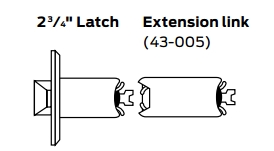
The Sargent 10-2053 (3-3/4 inch guarded) and 10-2057 (5 inch) are the large latch options in the Sargent mortise line. If an existing large-backset latch needs to be replaced and the correct extended latch isn't available, the Cal Royal GEN334 EXT (3-3/4 inch) and GEN5 EXT (5 inch) backset extension links attach to a standard latch body to bridge the gap. That's a useful retrofit option when the door prep can't be modified and the exact replacement latch is on backorder.
Ordering a Lockset Latch Replacement: Brand and Line Compatibility
The most common ordering error on latch replacements is mismatching the latch to the lockset line. Sargent latches are line-specific: 6-Line latches fit Sargent 6-Line cylindrical locks, 7-Line latches fit 7-Line heavy-duty cylindrical locks, and 10-Line latches are mortise components. A 6-Line latch will not install correctly in a 10-Line mortise body. The product listings in this catalog identify the line clearly, but if you're not certain which Sargent line is on the door, the model number on the lock face or the bottom of the lockset body is the reference.
Schlage latches (11-series) are similarly specific to their corresponding lockset families. Dormakaba latches in this catalog cover their cylindrical line with both 2-3/8 and 2-3/4 backsets. Cal Royal latches are interchangeable across more applications and work well as replacement options when an OEM replacement isn't available quickly.
Anti-Friction Dead Latches for Fire Door Pairs
The Cal Royal GND750 and CAL750 anti-friction dead latches serve a specific application: paired fire doors where positive pressure fire testing creates binding conditions on the latch bolt. Under the pressure differential that builds in a fire stairwell or corridor, standard latches on paired doors can drag against the strike in a way that prevents consistent positive latching. The anti-friction mechanism on these latches reduces drag at the point of contact with the strike, ensuring the latch engages cleanly under pressure conditions.
These are not a general replacement for standard dead latches. They're a specific specification item for fire door pairs in NFPA 80 assemblies where the AHJ or fire door inspector has identified a latching consistency problem.