 Trusted Since 2001


.svg)
- Exit Hardware
- Panic Exit Devices
- Sargent Panic Devices
- 80 Series Exit Devices
- 8300 Series Narrow Design Mortise Exit Device
8300 Series Narrow Design Mortise Exit Device
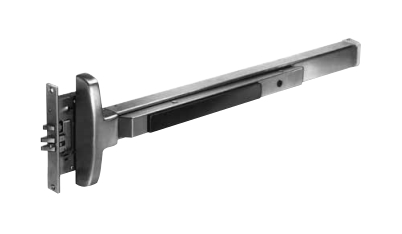
The Sargent 8300 Series is a narrow design mortise lock exit device from Sargent's 80 Series line - through-bolted trim, integrated mortise lock body, Grade 1 ANSI/BHMA certified, available in panic and fire-rated configurations for metal and wood door applications. American Locksets has stocked Sargent 80 Series exit devices since 2001. Free shipping on orders over $300 and same-day shipping available.
What the Sargent 8300 Series Is
Narrow Design. Mortise Lock. One Device.
The 8300 is Sargent's narrow design take on the mortise exit device. What makes it different from the rest of the 80 Series is the aesthetic profile - the 8300 is built for door stiles where the standard width stile design needs to look narrow without sacrificing the structural advantages of a mortise lock body. The mortise body sits embedded in the door edge, the trim is through-bolted for rigidity and quiet operation, and the result is a device that looks architecturally restrained while performing to the same ANSI/BHMA Grade 1 standard as any full-bodied 80 Series device.
This is not an Adams Rite product - if you searched "adams rite 8300," the correct answer is that the 8300 Series is a Sargent (ASSA ABLOY) product. Adams Rite and Sargent are both ASSA ABLOY brands, but they serve different door types. Adams Rite specializes in narrow stile aluminum storefront hardware. Sargent's 8300 Series is for metal and wood doors with standard width stiles.
Sargent 80 Series Exit Device: Where the 8300 Fits
The 80 Series Product Family
Sargent's 80 Series is a complete exit device platform covering every hardware configuration type - rim, mortise, surface vertical rod, and concealed vertical rod - in narrow and standard width stile designs. The 8300 Series occupies the narrow design mortise position within that family. Understanding where it sits helps with specification:
The 8300 Series (this category) is the narrow design mortise lock exit device - for standard width stile applications where a slim visual profile is required.
The 8900 Series is the standard width mortise exit device - concealed single-point guarded latching in the door mortise pocket.
The 8500 Series is the narrow design rim exit device - for applications where a mortise pocket is not available or not preferred.
The 8800 Series is the standard width rim exit device - for wood and metal standard stile applications.
The 8700 Series is the surface vertical rod - two-point locking with exposed vertical rods on the door face.
Knowing these distinctions matters because specifying the wrong configuration means a door modification, not just a hardware swap.
"8300/12" and "12 8300": The Fire Rated Variant Explained
Fire Rating on Sargent 8300 Devices
If you searched "8300/12" or "12 8300," you're looking for the fire-rated version of the 8300 Series. The "12-" prefix in Sargent's ordering system designates fire-rated hardware. So a 12-8304 is the fire-rated version of the 8304 function device, and a 12-8315 is the fire-rated version of the 8315 passage function device.
Fire-rated 8300 devices are UL listed under UL 10C positive pressure fire door test criteria. The critical operational difference from the panic-only version: fire-rated devices cannot be mechanically dogged. Hex key dogging and cylinder dogging options are not available on fire exit hardware. The device must self-latch when the door closes, every time - that's what fire-rated means operationally. If you're specifying for a rated stairwell door, a rated corridor door, or any opening in a rated assembly, confirm the fire label requirement with the authority having jurisdiction before ordering.
Functions Available in the Sargent 8300 Series
Selecting the Right Function for Your Opening
Functions determine how outside entry trim behaves - who can enter, under what conditions, and whether a cylinder is required. The 8300 Series offers field-selectable and factory-configured functions across a complete institutional range:
8310 - Exit Only / Dummy Trim: No outside trim operation - the device is exit only. Pull-only trim available as a non-functional outside element. Used for stairwell doors and restricted access fire exits where re-entry is not permitted.
8304 - Night Latch: Key in outside trim retracts the latch for entry. Outside trim is non-functional without a key. Common on exterior exit doors requiring authorized re-entry.
8313 - Classroom Function: Outside lever locks when inside cylinder is turned, key retracts outside lever. The institutional standard for K-12 classroom doors - outside lever locks on a single key turn without opening the door, compatible with lockdown protocols.
8315 - Passage: Outside lever always free to retract latch from either side. Used for corridor doors, connecting offices, and any opening requiring unrestricted two-way traffic. Shop the Sargent 8315F-32D Narrow Design Mortise Lock Exit Device - the passage function, 36-inch, less trim configuration available in this category.
8340 - Dummy with Freewheeling Trim: Outside lever is always free-spinning (freewheeling) - it does not engage the latch mechanism. Used for inactive leaves on paired doors where the lever is present for aesthetic continuity only.
8343 - Classroom with Freewheeling Trim: Classroom function with a freewheeling outside lever for enhanced security - even when locked, the outside lever cannot be forced to operate the latch.
700 Series ET Trims: The Outside Trim System
How ET Control Trims Work with the 8300
The Sargent 8300 Series separates the exit device body from the outside trim. The "ET" (Exit Trim) system lets you specify the outside trim independently from the exit device - matching the trim across an entire building without replacing devices when trim functions need to change.
710 ET - Pull Only Function: Fixed pull on outside, no lever, no key. Exit only from inside, grip-only entry assist from outside. Available for Sargent 710 ET_ exit trim for 8300 devices on this site.
713 ET - Classroom Function: Lever trim with classroom lockdown operation. Compatible with the 8300 and 8900 mortise and 8700 SVR devices. Shop the Sargent 713 ET_ classroom function trim for 8300 applications.
715 ET - Passage Function: Lever always active from outside. See the Sargent 715 ET_ passage function trim for this configuration.
740 ET - Freewheeling Pull Only: Free-spinning pull trim. Outside pull does not engage latch. The Sargent 740 ET_ freewheeling pull-only trim is available across 8300, 8500, 8700, 8800, and 8900 devices.
Electric Options for the Sargent 8300 Series
Electrifying the 8300 for Access Control
The 8300 Series supports a broad range of electrical options that convert it from a purely mechanical exit device into an integrated access control component:
56-ELR (Electric Latch Retraction): Remote solenoid-based latch retraction. Access control sends a signal, the solenoid retracts the latch for entry without anyone operating the push rail. Correct for access-controlled exterior doors.
58-Electric Dogging: Electrically holds the push rail in the depressed position for free egress - eliminates manual hex key dogging and allows schedule-based or remote control of the free-passage mode.
59-Electroguard (Self-Contained Delayed Egress): Built-in delayed egress system that triggers a 15-second alarm and delay when the push rail is operated without authorization. Meets NFPA 101 delayed egress provisions for retail loss prevention and secured-access facility applications.
53-LX Latchbolt Monitor: Switch monitors latch position - signals when the latch is retracted, providing door-open status to the access control panel.
55-REX (Request to Exit Signal): Rail-mounted switch sends a request-to-exit signal to the access control system when the push rail is depressed, suppressing the door-forced alarm at the panel.
AL-Alarm: Battery-operated alarm option that sounds when the push rail is operated.
Hardware Specifications: Sargent 8300 Series
Door Type: Wood and metal - 1-3/4 inch (44mm) standard; 2-1/4 inch (57mm) available.
Latchbolt: Brass nickel plated, 3/4-inch (19mm) throw, anti-friction.
Strike: Brass, bronze, or stainless steel; 8 inches x 1-1/4 inch; ANSI A115.1; adjustable angle; curved lip, non-handed.
Mounting: Wood and machine screws standard; through-bolts and mortise nuts available on order.
Chassis Cover: Cold drawn stainless steel, bronze, or bronze with ANSI/BHMA finishes.
Chassis Material: Nonferrous alloy (panic); ferrous alloy (fire-rated).
Certifications: UL listed for panic and fire exit hardware; ANSI/BHMA A156.3 Grade 1; Florida Building Code (FBC) listed.
Available Widths: 36-inch standard; 42-inch and 48-inch available.
Dogging: Hex key standard (non-fire rated); cylinder dogging (16-) available; electric dogging (58-) available.
Finishes: 3, 4, 9, 10, 10B, 10BL, 15, 20D, 26, 26D, 32, 32D (32D satin stainless most common).
Why Sargent 80 Series Outperforms the Field
When every architect spec sheet says "Grade 1 exit device," most people assume all Grade 1 devices are equal. They're not. The Sargent 80 Series exceeds ANSI/BHMA A156.3 Grade 1 cycle requirements by more than five times in static load testing - the test that simulates what happens when someone actually kicks a door or tries to force it. The through-bolted trim on the 8300 isn't just a design choice; it's what keeps the trim from loosening over years of high-cycle institutional use. The modular design means functions can be reconfigured without replacing the device body. And the full electric options suite - ELR, electric dogging, delayed egress, monitoring, REX - means the 8300 grows with your building's access control requirements rather than requiring a device replacement every time a new function is needed.
For K-12 schools where the entire building may need classroom lockdown capability within minutes of an incident, the 8300 Series with 8313 classroom function and the 713 ET trim is one of the most deployed configurations in institutional construction. For healthcare where delayed egress on specific corridors is required under NFPA 101, the 59-Electroguard option delivers a code-compliant self-contained solution without a separate controller. For commercial office buildings where the hardware schedule requires visual consistency across a narrow design door package, the 8300's narrow profile matches the architectural intent without the performance trade-offs that cheaper trim devices force.
Frequently Asked Questions: Sargent 8300 Series
Q: Is the 8300 Series the same as an Adams Rite 8300?
No. The 8300 Series is a Sargent product (ASSA ABLOY). Adams Rite makes narrow stile aluminum storefront hardware. The Sargent 8300 is for metal and wood doors.
Q: What does "12-8300" or "8300/12" mean?
The "12-" prefix designates the fire-rated version. A 12-8315 is the fire-rated passage function device. Fire-rated devices cannot be mechanically dogged.
Q: What's the difference between the 8300 and the 8900 Series?
The 8300 has a narrow design aesthetic profile. The 8900 has a standard width profile with a concealed single-point guarded latch. Both are mortise exit devices.
Q: Can the 8300 Series be used for classroom lockdown?
Yes. The 8313 classroom function with 713 ET trim is widely specified in K-12 applications for one-turn lockdown from inside.
Q: What ET trims are compatible with the 8300?
The 710, 713, 715, and 740 ET trim series are all compatible with the 8300 Series - pull only, classroom, passage, and freewheeling configurations.
Q: What widths are available?
36-inch is standard. 42-inch and 48-inch are available on order.
Q: Can the 8300 be electrified?
Yes. ELR (56-), electric dogging (58-), Electroguard delayed egress (59-), latchbolt monitor (53-), and REX (55-) are all available options.
Q: What's the latchbolt throw?
Brass nickel plated, 3/4-inch (19mm) throw, anti-friction design.
Q: Is the 8300 UL listed for fire doors?
Yes, the fire-rated (12-) configurations are UL listed under UL 10C positive pressure. Confirm the specific fire label with the authority having jurisdiction.
Q: What's the difference between hex key dogging and cylinder dogging?
Hex key dogging uses an Allen key inserted into the push rail to hold it depressed. Cylinder dogging (16-) uses a key in the outside cylinder for a cleaner operation without a separate tool.