 Trusted Since 2001


.svg)
- Exit Hardware
- Panic Exit Devices
- Dormakaba Devices
- Dormakaba 9100 Series
Dormakaba 9100 Series

$2,829.00
$1,584.24
What the Dormakaba 9100 Series Is
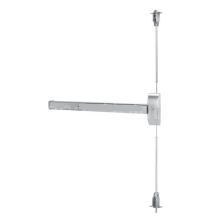
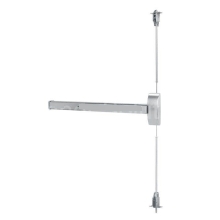
The dormakaba 9100 is a wide stile concealed vertical rod exit device and the CVR member of dormakaba's 9000 Series premium exit device family. Where most exit device manufacturers use extruded aluminum for the device chassis, the 9000 Series uses a heavy-duty cast chassis - a construction difference that produces meaningfully greater durability under high-impact institutional use conditions. Schools, universities, hospitals, and government facilities with door cycles running into the hundreds per day are the primary applications. The cast chassis handles sustained abuse that would deform or fatigue an extruded body over time.
The touch bar assembly has a smooth, reduced-projection profile that minimizes catch hazards in high-traffic corridors. The partial-length touchpad design leaves room along the device body for field installation of options - exit alarms, cylinder dogging, latch monitors - without factory pre-ordering.
Dorma 9100 vs Dormakaba 9100: Same Device, New Name
Most specifiers and facility managers who search for the "Dorma 9100" are looking for this exact product. Dorma and Kaba merged in 2015 to form dormakaba, and the 9000 Series premium exit device line carried over from Dorma into the combined company without a product redesign. The specifications, construction, and option codes are continuous across the Dorma and dormakaba catalog eras. If your hardware schedule reads "Dorma 9100" from a project that was specified before or during the brand transition, the dormakaba 9100 is the current production equivalent.
9100A vs 9100B: Door Width Determines the Suffix
The A and B suffixes designate the bar length, which corresponds to the door width being served.
The 9100A is sized for doors up to 48 inches wide (4-foot door openings).
The 9100B is sized for doors up to 36 inches wide (3-foot door openings). Both are wide stile concealed vertical rod devices on the same cast chassis platform. The wrong suffix means the bar either doesn't span the door face correctly or projects beyond the stile geometry - either creates an installation problem that requires a return.
The 8 suffix on the 9100B8 designates 8-foot door height, extending the top rod to cover the taller door. Standard configurations cover 7-foot doors. If the door is taller than 7 feet, specify the correct height designation or use the ETR (Extended Top Rod) option, available for 8, 9, and 10-foot heights.
F9100: The Fire-Rated Version
The F prefix designates the fire-rated version of the 9100. The F9100 carries a UL 10C listing for fire-rated door assemblies and complies with NFPA 80. It's also listed with the California State Fire Marshal for projects in California.
Any door assembly carrying a fire rating - stairwell doors, corridor fire doors, exit enclosure doors - requires a fire-rated exit device. Using a standard 9100 (non-F) on a fire-rated assembly is a code violation that surfaces at the NFPA 80 annual fire door inspection. The F9100 is the correct specification for those openings.
Dormakaba 9000 Series Exit Device Options on the 9100
The 9100 supports the full dormakaba 9000 Series option set. These are the most commonly specified:
MLR - Motorized Latch Retraction. A motor concealed inside the touchbar assembly retracts the latchbolt by drawing in the touchbar. The MLR is whisper quiet, runs on lower continuous current than a solenoid, and can be momentarily unlocked for credential-controlled entry or to electrically hold the bar in the dogged position during business hours. Compatible with card readers, key switches, and any device providing a normally open contact.
ES - Electric Latch Retraction. The solenoid alternative to MLR. Rated for 24VDC, requires the PS501 power supply and ES105 power transfer. Available as fail-secure or fail-safe depending on egress path requirements.
DE - Delayed Egress. 15-second delay with simultaneous local alarm. Available on the 9100 in standard and California Building Code versions. 30-second delay (D3) requires AHJ approval.
CD - Cylinder Dogging. Key-operated dogging using a mortise cylinder. Allows the touchbar to be mechanically held in the dogged (retracted) position for free-passage operation.
BA/BAR - Battery-Powered Exit Alarm. Local alarm sounds on door use. BAR adds a 4-minute reset delay. DA provides direct-wired alarm connection to the building system.